7 Questions To Ask During NaNoWriMo [especially if it’s tough and before you gut yourself for how bad it’s going wordcount wise]

Day thirteen of NaNoWriMo.

For the peasants (aka: regular people) who don’t know, NaNoWriMo stands for National Novel Writing Month—an event that now spans the globe as writers from all walks of life and stages in the writing journey attempt to write a whole new novel in one month (or, at the very least, 50,000 words in one month).

This is my third and worst NaNo. Last year, I wrote the first draft of False Gods during NaNoWriMo, and it seemed like I had struck a healthy balance of imbalance (trust me, that will make sense in a moment I hope).

Some days I would write 8,000 words in a day. And sometimes I’d write only 17. I wanted to write that story so badly, was so ready to get it rolling. I never felt burned out of it or uninterested in it; some days there was just too much going on in the rest of life and I was fine with writing very little. Other days it just sort of exploded.

‘Tis not so with NaNoWriMo 2018.

In case I’m not the only one having trouble, here are seven questions to ask yourself during NaNo, especially if the going is rough.
 

7 nano questions 2.jpg

I. Have you picked the right story?

Maybe your idea isn’t ripe yet. Perhaps it needs to simmer for a while longer. This leaves you with a few options.

You can A) try to finish the story anyway, but I warn against this because while art requires discipline, it isn’t something you can force.

B) Try writing another novel, but you probably shouldn’t expect to finish this new one before the end of the month unless you generally draft a novel in just a few days.

C) Write some short stories instead, contributing those words to your NaNo wordcount.

D) Don’t finish NaNo. This is actually fine. It sounds like a sin for some reason (probably because we writers are a bit obsessed), but the world won’t end, my friends.

E) Continue working on the story at a much slower rate, one that allows the idea to grow.

II. How much time are you spending on social media?

For me, the answer is usually way too much. I have grand plans of cutting myself off from social media, but alas they never seem to come to fruition. My copy of Deep Work glares at me from the bookshelf. (Oh, right. I’m writing a blog post about that book, aren’t I?)

However, all of my writer friends live far away, and we connect most easily on social media. So for word wars and encouragement and such, social media is incredibly helpful.

But. Alas. It’s so easy to get pulled into the scrolling quicksand. And then all sorts of life-sucking things like comparison, zoning out, etc. creep in and… ahem, suck the life out of you.

I’ve found that lack of creativity is often directly related to a surplus of time spent in the depths of social media. So if you’re feeling drained, uninspired, depressed, or all of the above, maybe take a break from your social medias for a few days. Or limit your time to fifteen minutes to see if that helps.

III. Are you starving yourself creatively?

Sometimes I get into this rut where I think if I’m working on a story, I can’t enjoy other people’s stories. As if I don’t have the time right now or I’ll reward myself with a book or movie after NaNo is over.

Typically, this starves me.

Reading is one of the most relaxing and rejuvenating things for my imagination, and movies provide a break to simply take in a story visually. When I read for even just a half hour, my creative blood flows more easily.

Perhaps you’re like me. Maybe you need story input in order to have story output at a high rate.

IV. Are you feeding yourself the wrong brand/genre of creative food?

Are you reading/watching/drawing a bunch of things that get your mind exploding in a different genre?

Variety is important in a creative’s diet, but sometimes—like when you’re drafting a new novel–it’s important and helpful to guard your imagination from the wrong genre of inspiration. There are some stories that you know ignite your imagination for a certain brand of story.

The Lord of the Rings will never not inspire me to write epic fantasy.

Dracula will (apparently) never not inspire me to write a steampunk vampire story that’s basically just a fan fiction of Dracula. (Seriously, guys. I have been blown away by Dracula. I was expecting to not like it, but I think it’s better than Frankenstein and The Picture of Dorian Grey combined.)

The Lion King will never not inspire me to work on False Gods.

The new Star Trek movies (as wild and crazy and sloppy as they can be) will never not inspire me to get to work in the Stars and Soul storyworld (which also happens to be the same storyworld as my NaNo novel this year).

So consume the stories that jumpstart your creativity for this NaNo story. Know the music, books, and movies that make you squirm to create something in the genre of your NaNo novel… because then, hopefully, it will give you more energy to create your NaNo novel.

V. What else is going on in your life that affects your art?

Are you in college? Studying for exams? Preparing to move? Settling in after a move? Working extra hours? Taking care of a newborn? Remodeling the house?

For me, the things that are affecting me the most are my upcoming move to Texas, all the things I want/need to do/say before I make the move, and the release for Stars and Soul (November 20, my dudes).

Stories have always been a sort of refuge for me, and in the past I’ve viewed writing as a sort of refuge, blocked out from the rest of the world. But I know now that my writing is intimately tied to the rest of my life.

If this NaNo is hard, don’t beat yourself up for it. Take a step back to see what in this season of your life is affecting you. It’s important to remember that you are not the same person you were last November. Your life is not the same it was last November. And your life will not be the same next November.

Don’t expect to create in the same way, with the same speed, with the same ease as you have in the past.

VI. And what about God?

Is your relationship with God—the time and attention and desire—suffering because of NaNoWriMo?

Are you writing with God, or are you going at it alone? Are you making time for Bible reading, personal worship, and prayer? Or are those spiritual disciplines—the lifeblood of our relationship with God—getting axed? And it likely isn’t that you don’t want to be steadfast with God; it’s just that work, school, writing, sleeping, etc. quickly crowd those disciplines out.

It is so easy for the glittering, heavily caffeinated fun of NaNo and the new novel and the word wars and the Pinterest board and these characters to silently, deftly, speedily displace Jesus in our minds and hearts.

So think about this question. Dwell on it. Pray about it. Don’t shy away from God or your own heart. Be honest.

Or maybe things have never been better with God. In which case, savor him.

VII. Do you have to draft a new story this month? What is motivating you?

I.e. – why are you doing NaNo? Is it because you’ve always done it? Is it a matter of writer pride? Something all the other writers talk about that you wanted to try? Because you have a story that just needs to be written?

Check your heart. It’s not that any of these are bad reasons to do NaNo. It’s just that it’s okay to not write a new story this month.

Basically, even if NaNo isn’t going as you imagined it would, and you see your friends splattering their 40,000 words all over social media, it’s okay. It. is. okay.

Your life is not writing. Your identity is not writing. You’re no less a writer if you don’t finish your novel this month. You’re no less a writer if you don’t write 50,000 words this month.

And maybe not finishing NaNo is failure.

I won’t say that it isn’t because your definition of failure depends on your definition of success. For some, not finishing NaNo will be failure. In which case, good because it needn’t be a bitter failure. Better for it be a failure that teaches you your weaknesses and limitations rather than it be a “success” that leaves you stress-ridden, depressed, snappy, and unfocused on what will always matter (i.e. – God and other people).


This NaNo’s been tough for me. At the time of this post writing, I’m little over 8,000 words for the month (I should be at 20,000). I’ve gotten stressed about it (surprise, surprise), and I need to daily take a step back and ask myself these questions. Especially those last three.

If you’re doing NaNo and it isn’t going well and you’re stressed, hopefully these questions will help you work through some of that stress.

So, friends. Are you doing NaNo? How is it going? What are your thoughts/advice for when NaNo is tough?

With love,

Rosalie

p.s. – people have asked to see the Stars and Soul Pinterest board. You, my friends, are going to get the link first. <3

p.p.s. – yeah, no High Command memo went out last week. It’s just one of those things that may not happen again until I’m in Texas.
Stars and Soul [endorsements & cover reveal wrap]

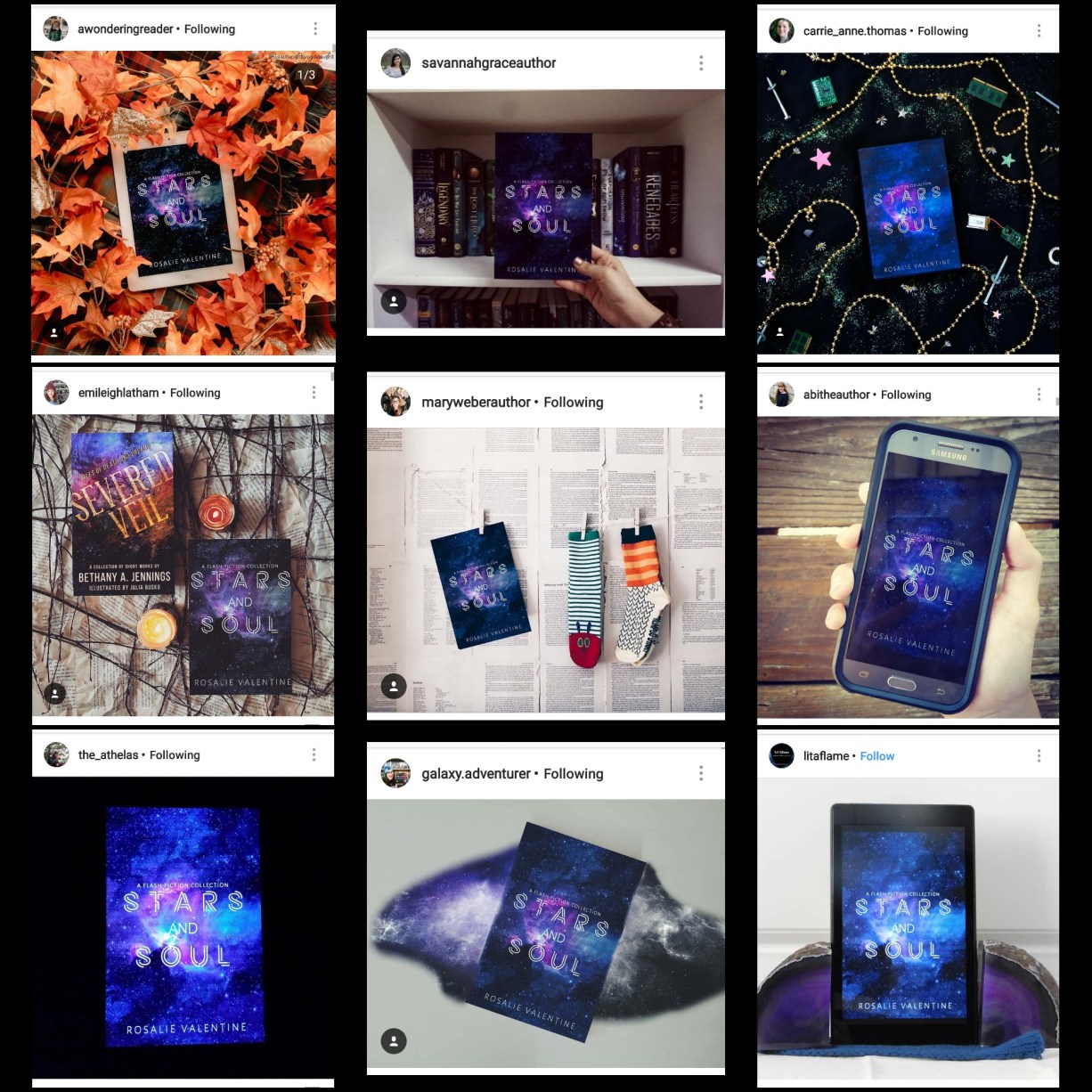
Today’s post is basically just a giant celebration. Because on Saturday, the cover for Stars and Soul started exploding across the internet. And when I say exploding, I mean e.x.p.lo.d.i.n.g. My phone would not stop buzzing.

Alea Harper designed a stunning cover, but I was honestly afraid it would be just me and like my dad (who has no social media) sharing the cover and inviting people to preorder.

Alea totally deserves to have this piece of art blasted across all the social medias, but I was worried people would be too uninterested/scared away because this I’m young, small potatoes, and self-publishing this little collection.

*cue my socks getting blown off and then blown up*


// What Is Stars and Soul? //

In case you’re new here, Stars and Soul is a collection of four flash fictions (stories under 1000 words) set in a sci-fi world with aliens and alliances. It is set to release November 20, 2018. Right now, the Kindle copy is available for pre-order, but there will also be a tiny paperback available on the release day.

Here is the official blurb: A scheming imperial family. A bedraggled starship captain. A runaway artificial intelligence. A dying general. Four small stories of stars and soul.


// The Social Media Turnout //

There were way too many Facebook posts, Instagram posts, Instagram stories, and blog posts to keep track of over the course of the cover reveal day. Some of you never signed up for the reveal but joined on the day of, and you blessed me so much.

Thank you so much to Mom, Arielle, Katie Grace, Moya Tobey, Abigayle Claire, Amanda Hookham, Liv K. Fisher, Carrie-Anne Thomas, Kira Thomas, Bethany Jennings, Jaye L. Knight, Savannah Grace, Mary Weber (freaking. Mary. Weber), Katherine Massengill, Julian Daventry, Pam Halter, Ashley Townsend, Lydia B., Jenni Wojtowicz, Julia Anne, Kenzie, Elizabeth Koetsier, Elizabeth Hafferty, Brittany Valentine, Dominique Sprouse, Nadine Brandes (um, what?), Emileigh Latham and Stephanie Warner for leading the charge on Facebook, Instagram, and Twitter. (I know there were more, but I literally couldn’t keep track of all the IG stories and Facebook shares.)

cover reveal collage 1.jpg

some #bookstagram posts


// The Blog Posts //

S&S cover reveal graphic.jpgThis hilarious, gif-ful reveal from Savannah at Inspiring Writes (also, Savvy just got on Instagram and Youtube, so go give her some love!!).

This lovely blog post from Serethiel over at The Book Sprite.

Jaye L. Knight also shared the cover with a blog post!

Katherine Massengill (a fellow flash fiction enthusiast who has participated in the Penprints Flash Fiction Dash) also featured the cover on her blog!

Julian Daventry (another #flashficdash alum!) also put together a blog post for the reveal!


// A Few Endorsements //

I’ve received some very glowing endorsements, and so I’m going to share them here first and then let them trickle out over my Facebook and Instagram as November 20th approaches. :)

STARS AND SOUL COVERWhen I made my list of people to contact about endorsements, I comprised it of people who a) know sci-fi, b) know flash fiction, or c) have experience with both. The people who agreed to read took my breath away with their words of encouragement and endorsements.
>> “Rosalie Valentine’s Stars and Soul opens a window into a galaxy rife with intrigue and danger, a place home to disparate peoples striving to survive. A scheming empress-in-waiting — a weary captain of a malfunctioning starship — androids seeking refuge — a general facing laments — all bring the ‘soul’ promised by the title in memorable ways. A fun, thoughtful, quick read.” — Steve Rzasa, author of The Face of the Deep series

>> “Rosalie Valentine needs no more than 1,000 words to send your emotions stirring. Her flash fiction is an art of storytelling blended with the human senses—leaving you both wanting more and yet extremely satisfied when you finish. I could lose myself in her writing all day.” – Nadine Brandes, author of the Out of Time series, Fawkes, and Romanov

>> “Rosalie Valentine has crafted an intriguing universe of flesh and machine that expands with each story told. Stars and Soul is sci-fi with heart and endings that leave you wanting more!” – Just B. Jordan, author of Never to Live and To Ashes We Run

I have no words. Please excuse me while I go bury my face in a pillow and shed some many tears.


// The Necessary Details //

You can pre-order Stars and Soul on Amazon, and you can add it on Goodreads, if you like. It will release on November 20, 2018.

#starsandsoul #starsandsoulcollection

Thank you all for blessing me. <3 My heart is so happy.

With love,

Rosalie <3

p.s. – that binary code on the cover, tho. Alea read the stories and scrolled through my Pinterest board, and I was so happy when she put code on the cover. You’ll know why later if you read the third Stars and Soul story.

Sense of Red [a flash fiction with author’s notes]

Preface.

I almost didn’t share this flash fic because it is not my best. In fact, it is probably one of the angriest, sappiest, most emotion-driven things I’ve ever written.

I took my feelings and confusions about jealousy (not romance-related) and dropped them into a love triangle story; how could it possibly get melodramatic?

sense of red.jpg


// Sense of Red //

What was the threat of ten years in prison compared to love? Nothing. Absolutely nothing. At least, ten years was what Riley figured he would be sentenced to if he shredded the two paintings hanging on the museum wall. Five years a piece.

But then, this wasn’t love.

This was knowing that Jacob would propose to Elena in just one hour in front of these exact paintings, a Monet and a Van Gogh. And Riley wouldn’t give a rip about Jacob and Elena kissing and crying and celebrating their engagement. He wouldn’t. Not even a rip.

It’d been what?—four years since he and Elena had broken it off? He was over it. So far over it.

And Jacob was his best friend, had been since they were first paired as chemistry lab partners. Jacob’s logical brain had saved Riley’s flagging math and science grades while Riley’s poetic guidance was the salvation for Jacob’s art appreciation class. From then on, it was the two of them back-to-back against the world. Not to mention that Jacob had asked Riley at least ten different times if he was okay with him dating Elena, had triple-checked that Riley wasn’t harboring any lingering feelings for her, and Riley had said “no” every time.

Yet whenever he saw them together, something molten shot through his veins, and he swore his bones were melting under the heat.

Because while Jacob couldn’t tell the Van Gogh from the Monet if they slapped him in the face, Elena and Riley had debated and marveled and shared so much over every exhibit, driving five hours to see a Raphael in person, pouring over every detail and every theory behind each piece of art.

Because he could still see her dark, rich eyes inches from his own and taste the breaths they shared after a kiss, could still smell the salt from her joyful tears when he sold his first painting. Ever this heady desire, this understanding of what fueled the greatest of the artists and romantics because it ran through him whenever he was with her.

Because he’d spent the last four years saying things with his lips that he didn’t believe for one second in his heart. Four years should have been enough to get over it, to move past it, but it wasn’t.

So before he did something worth prison, he would go home to his lonely little apartment and paint something to deal with all that pulsed through him. Something with lots of angry color. Something that captured the desire to punch Jacob, kiss Elena, take a knife to the most beautiful art on the planet, and burn the whole place to the ground. Something to help him deal with this sense of red.

The Monet and the Van Gogh would be left unscathed, and Jacob and Elena would never know of anything besides how very, very happy he was for them because they were both far too dear for anything else.


Author’s Note.

I wrote this flash fiction over a year ago, and since then, I’ve learned a lot about flash fiction, writing, and life.

I am a deeply jealous person (which apparently surprises most people?), and I wrote Sense of Red at a time when my jealousy was flaring especially high. On top of all the emotional wreckage I was sorting through, I also tried to figure out if my jealousy was wrong, or if it was an emotion to teach me something of God’s jealousy.

After much prayer, study, and meditation, I came to realize that, no, jealousy is not inherently wrong. And, yes, it’s given me some insight into my jealous God. However, jealousy is powerfully tied with anger, and I, in my fallen human nature, am not pure and infallible like my jealous God is.

Jealousy in fallen people treads a dangerous and thin line, easily stemming from and crossing over into envy, idolatry, and pride. Someday I may write a more extensive post about the red of jealousy and the green of envy, but this will do for now.

Writing Sense of Red was like therapy. It helped me process my extremely volatile emotions instead of my emotions processing me.

May God use your own writing to help you grow.

With love,

Rosalie

p.s. – Stars and Soul is now up on Goodreads! Go add it (because I promise those four stories are much better than this one)!! And we’re less than a week until the cover reveal! Eep!

Why The Lion King [in which some of the greatness of this story is explained]

The Lion King is one of my all-time favorite stories.

People tend to look at me funny when they discover this. Apparently, it’s sort of weird that it’s not only one of my favorite animated movies but one of my favorite movies period.

I don’t have very many hills I’d die on. But, the greatness of The Lion King is a hill I’d die on. As it turns out, it’s one of those rare things I’ll drive a stake into the ground and yell “FIGHT ME!” over.  Which is an unusual show of rabid hostility from me. But, alas, I am unashamed.

rafiki 6.gif

hint: i am rafiki

So here we are with this post.

why the lion king

First, let’s dispel some common misconceptions.

Before we get into what The Lion King is all about (aka: why it is so amazing), we need to talk about what it isn’t about. These are just some things that I’ve noticed distract people.

look harder 1.gif

me to people every time they get confused about what this story is about

It is not about “hakuna matata.” It is not about having no worries or shirking responsibility or having stupid fun with the bros. If this story was about Timon and Pumba, then it might be about hakuna matata. But it’s not about Timon and Pumba.

It is not about how amazing James Earl Jones is as Mufasa. (Though, I mean, come on. He is the best and only Mufasa. #mufasaforever)

mufasa 1

mufasa 2

mufasa 3

parenthood 1

It is also not about how sad Mufasa’s death was…

sad simba 1

but I mean, dang, it was pretty crushing

It is not about all the funny memes that can be created from the “where the light touches” scene (you know of what I speak).

everything the light touches.gif

It is not about the circle of life or the spirits of dead kings being stars. While “The Circle of Life” is majestic song and a brilliant opening scene, this is not a story about the circle of life. The circle of life is a reoccurring symbol.

Now, onto the good stuff.

If the circle of life is a symbol, what does Mufasa mean when he tells Simba to take his place in the circle of life?

mufasa and simba.gif

It means, my friends, be who you were born to be. Do what you were designed to do.

It means take the responsibility. Grow up. The time for games is over. The time for childishness is over. (Instead of “I Just Can’t Wait To Be King,” it is “King of Pride Rock.)

It means that your potential isn’t about you, and it means that wasted potential harms not only you but also those you are meant to help.

It means get over yourself and your fear because this is so much bigger than just you.

It means that true greatness is not self-seeking. True greatness is taking on great burdens for the sake of others. It means step up. It means embrace the difficulty and the stress and the responsibility because you are the person for the job.

And it means that when you begin to step into your potential, when you put childishness behind you, it will not be easy, but nothing else will be so right.

That is what The Lion King is mainly about.

But there is yet more.

rafiki 5.gif

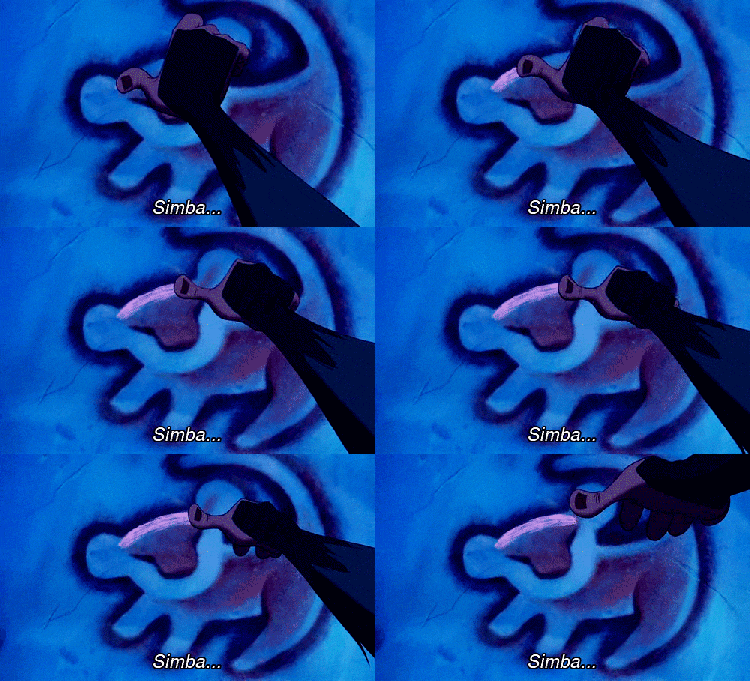
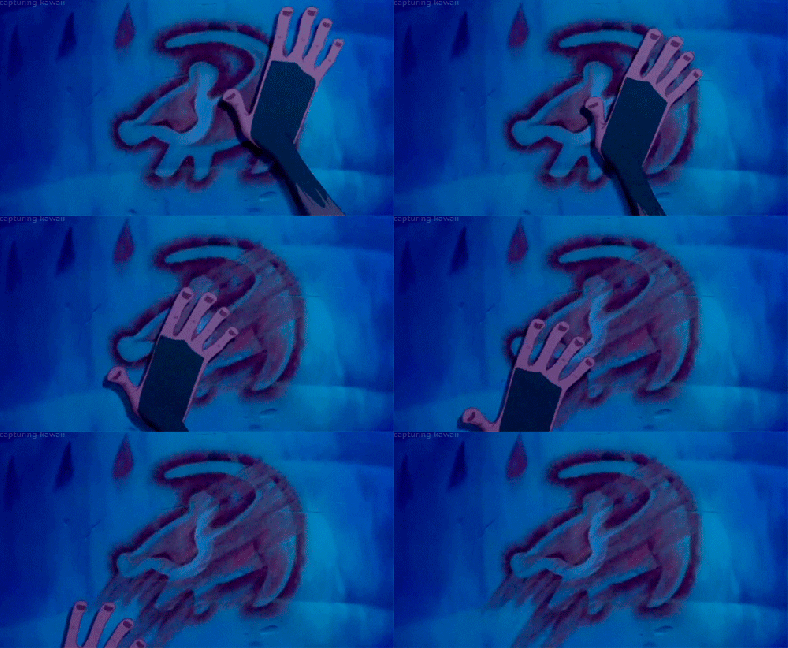
In the beginning, we watched Rafiki happily and hopefully paint a little lion in his tree. He was happy and hopeful not because baby Simba was already a great king; Rafiki was happy and hopeful because of the great king he believed Simba would one day become—a great king who would lead the Pride Lands into another generation of abounding life.

simba 2.gif

In the middle, we watched Rafiki smear his little lion painting in despair for he thought the bright future of the Pride Lands was dead with Mufasa and Simba.

simba 3.gif

But. then.

Then, Rafiki learns Simba is still alive. And The Lion King is also about that moment: it is about Rafiki’s incredulous, raucous joy when he discovers that Simba is still alive.

rafiki 4.gif

simba 7.gif

When hope had been gone for so long, and then suddenly finding that hope is alive and well. There is nothing like that wild rush of wild joy.

It is about how Mufasa looks down on Simba, a shape in the clouds, calling Simba to remember who he is.

remember who you are.gif

It is about how that rings in my bones as a call to remember who I am—whose child I am, whose slave I am, what gifts and callings have been written in my very cells.

It is about the strangely wonderful gooseflesh that flashes through when the rightful, true king at last takes his place.

rightful king 2

rightful king 5

It is about the rain that washes away the death of the night and begins the healing process.

healing 1.gif

healing 3.gif

I love Simba and The Lion King for the other, greater stories they reminds me of.

When I see Simba making that run from the jungle back to the Pride Lands, I also see Leo from the Tales of Goldstone Wood trekking to find Rose Red.

When I watch Simba climb Pride Rock in the rain, I also see Aragorn finally embracing his calling and responsibility as the true king of Gondor, and I see all the hope and healing his return brought to the White City.

But more than that, I see Moses returning to Egypt after all those long years of exile, becoming the great and humble prophet he was knit together to be.

Most of all, I see Jesus. I see Jesus drinking the cup given Him by the Father, drinking it to the dregs. I see Him dying, victorious. I see Him rising, victorious. I see Him returning, victorious. Forever victorious.

I see the dead coming back to life, and the great, final healing He will bring about. I see all the prophets rejoicing—wildly, raucously—for the One, at last, fulfilling all their visions. I see every knee in heaven and on earth and under the earth bowing before our long-awaited true King. I see the saints and angels crying out, “All hail King Jesus.

This is the strange and wonderful power of stories.

Through characters that have never really drawn breath, echoes of truth resound. Those echoes ricochet deep in us, moving, encouraging, calling out, galvanizing.

Set in the breath-taking African plains, The Lion King is one of my favorite stories. And now you know why.

rafiki 3.gif

What is one of your favorite stories? What is one of your favorite animated movies? Tell me why!

With love,

Rafiki Rosalie

p.s. – so, yes, feel free to send me The Lion King related gifts. (But if it’s hakuna matata related, I might burn it.)

The Stories We Will Tell [musings from my recurring existential crisis about Christian art]

This post is five years and six tries in the making.

It is not my usual trying-to-be-helpful/5-tips-for-xyz/oh-and-here’s-a-book-and-a-playlist-I-recommend-on-the-subject sort of post. I already tried to write this post in those formats and a few styles as well. It didn’t work.

So this is more journal entry/stream-of-consciousness.

I am a Christian, and I am a storyteller. Welcome to my angsty thought life regarding the marriage of my Christianity and my storytelling.

The Stories We Will Tell.jpg

This is me, for the last five years, about every story I’ve written:

I’m a Christian. Do I write Christian stories? Or am I a Christian who tells stories?

Is this too preachy? Or is this subject matter too dark?

I’m twenty years old. Am I old enough to write this sort of stuff? Will I ever be “old enough” to write this stuff?

My mom will read this. Will she squirm?

People at my church may read this. Will they judge me?

People I’ve never met may read this. Will this help them?

Should I paint the world and humanity as it is, how it should be, or how it could be?

On one hand this story has blatant themes of true greatness, healing, and hope. But it is steeped in kidnapping, stonings, family dysfunction, betrayal, murder, torture, idolatry, and self-obsession. (False Gods)

Will the Christian community condemn me for this? Or are they willing to see into the dark to see why it’s written like this? Can they see that every layer of darkness and depravity has a role to play in contrasting every layer of light and goodness?

Will the non-Christian community scorn me for this attempt at art? Or will this break down barriers and show Jesus to those who have never known him?

Am I writing to entertain, challenge the comfortable, befriend the lonely, raise questions, answer questions, tell it how it is, tell it how it can be, glorify God, or all the above?

On one hand this story showcases one small step to healing. But it is filled with anger, bitterness, grief, and violent death. (Start With Their Names)

Is my Christianity coming through too obnoxiously in this story? Or does this look no different from what the world has to give?

If I include a God-figure, am I capable of writing it well? If I cannot write it well, how do I portray a world without God? Is it wrong for me to portray a world without God? Is that some sort of betrayal of the truest, most real Person in the universe?

Why does it feel like I’m overthinking this? Why does it feel like I’m not thinking about it enough?

These people who I love and respect think that Christian art in general is not done well. And they think I shouldn’t write Christian stories. These other people who I love and respect think that I shouldn’t go too dark, are concerned when my stories aren’t moral or light enough. Which is right? Are either of them wrong? Is it possible for me to execute overtly Christian art well?

On one hand this is a story of new life, light, love, grace, and family. And in its backdrop sit shame, extramarital sex, abandonment, and disownment. But without the latter, can the former shine so brightly? (Unexpected)

Am I reaching too far with this story? Can even a fraction of this vision in my head be achieved on the page?

Do I have what it takes to tackle all of this? Do I have what it takes to bridge this gap between excellent art and the Christian community? Does it matter at all if I have “what it takes” or not as long as I pursue God’s glory through excellent storytelling?

Should there even be such a thing as specifically Christian art? Should I write stories for other Christians, or should I write stories for non-Christians? Is it possible to do both?

At what point should I just quit caring what people think and just work to tell a good story?

What even defines a good story? Can there be an excellent story that isn’t “good”? Or does excellence denote goodness? And what sort of goodness are we talking about here? Moral goodness, craft excellence, or something else?

Will it really kill me to just write fluffy stories since those don’t tend to step on any toes? Oh, wait, those do step on the toes of the people who don’t appreciate the unique value of a fluffy story. What now?

On one hand, this story is all about perseverance, responsibility, and self-sacrifice. And yet it also includes mild gore and torture while touching on genocide. (That Last Breath)

Will people think differently of me if I write dark stories? Is that a bad thing? Does it really matter what they think of me?

If they will condemn me because of truth of human nature (aka: depravity) in my stories, do I really care what they think?

If they will insult me because of the flaming arrows pointing to Jesus in my stories, do I really care what they think?

Speaking of Jesus, what does he think about all this? What does he call me to do in this?

Can I live with people misunderstanding my intentions, insulting me, or condemning me as far as my storytelling goes if I know I’m writing what I’ve been called to write? Basically, do I really believe Jesus’ opinion is enough to render all the others moot?

There is no good way to finish this post, and so I’m going to drop the bookend here.

These questions (and more) come back again and again with every story that I write. The only thing I really know for sure is that I’m called to pursue excellence in storytelling for the glory of Jesus.

I must learn to tune out the conflicting, raging opinions around me and focus in on Jesus and what magnifies him. It’s not always going to be obvious. It’s not always going to be subtle. But it must always be the motivation and end of every story I write.


Thank you to Caleb Valentine, Janie Valentine, Katie Grace, Nadine Brandes, Tony Reinke, Stephen E. Burnett, Jackie Hill PerryMary Weber, Tosca LeeLindsay Franklin, Steve Laube, and Aimee Meester; though you may not have known it, your friendship, books, teaching, example, discussions, podcasts, and/or blog posts have been helping me think through this issue for quite some time.

Thank you to Daddy for not being freaked out by the wide variety of stories along the Christian storytelling spectrum that I’ve thrown at you.

And thank you, Jesus, for who you are. You are not tame. You are not dark. You are not clean. You are completely holy. You are endlessly creative. You are always good.

Hopefully this question-filled post will help you figure out the kind of stories you will tell.

With love,

Rosalie

P.S. – sorry for being AWOL last week, my friends. My brain hiccuped, and then it was too late to put together a good post for last week. So here we are.

P.P.S. – what about you? What’s the deal with the stories you tell?