Advent: Hope and the Prophets

Christmastime is here, and this year on Penprints I’ll be going through some advent (of a kind—nothing here on Penprints is exactly traditional, and advent will be no exception).

advent-1

English takes advent from the Latin word adventus which means “a coming”. For Christians at Christmastime, that means a coming of Christ–specifically, His first coming as a baby. As lent is meant to prepare our hearts to remember and celebrate the death and resurrection of the Jesus at Easter, advent readies us to reflect on and celebrate His birth.

The advent of Christ has been foretold since the protoevangelium in Genesis 3:15, right after sin and death entered the world. Throughout the entire Old Testament there are prophecies about Jesus’ first and second comings, and for advent today, I’m thinking about the all the O.T. prophets who heard from God.

Imagine this:

You are a prophet. You have been called by God, by Yahweh.

Propheting (that is definitely a word) is a rather lonely business. Your parents, siblings, and friends will reject you, and if you get married, it’s possible (probable, even) that your wife and kids will be an object lesson for Israel. Speaking of Israel, as a prophet it’s your job to communicate the words of Yahweh to His people who have been known to throw prophets in wells. And since, in general, people (including the Israelites) don’t respond well to what Yahweh has to say, they typically don’t like you either since you’re His spokesman. So, propheting is lonely.

But Yahweh speaks to you. Audibly and in dreams and visions. And He’s told you to write down what He says. The longer you serve Him, hear His voice, see His mighty hand, and write down His words, the more you begin to see the world like He does.

When Israel goes after another “god” again, you weep.

When Yahweh tells you He’s raising up a nation to enslave Israel, you understand why.

And when Yahweh says that a Son of David is coming, a Lamb, One who will bear the iniquity of all, you think your heart will burst from the excitement, and you write it down. Yahweh doesn’t say when, but the more He tells you of this Prince of peace, this Root of Jesse, the more you can’t wait for Him to come.

There’s a lot about His plan that you don’t understand, but it’s Yahweh. His thoughts aren’t your thoughts, and you have complete confidence in the Holy One of Israel. Years slip by. You see many of Yahweh’s words unfold as events. And you continue to serve Him. When He speaks, you listen. He tells you many more things which you dutifully write down and tell whoever you’ve been commanded to tell.

But you haven’t seen the Son of the Most High yet.

You wonder when He’ll come. You wait for Him. You know that when He does come, Israel will wander and weep no more and Zion will rejoice.

And as you get older, you realize that some of what Yahweh has told you won’t come to pass in your lifetime. You know that Yahweh may tell many other prophets about this Emmanuel before He actually comes. And as your life comes to its end and you look back, you see all the ways that Yahweh is faithful. He never breaks His promises. You cling to Yahweh and His promises, and you know that your life and all your hope in the promised Messiah have not been in vain.

The Mighty God is coming, and when He arrives, He’ll set everything right. You hope He comes soon.

The prophets waited in hope and expectation for the coming Messiah, and we are to follow their example. As we celebrate Christ’s birth, we must also remember that He is returning.

This week, I encourage you to study and reflect on all the hope that Jesus has fulfilled—in the centuries of prophecies and in your own life.

Some passages to look at are: Genesis 3:15, Genesis 49:10, Isaiah 7:14, Isaiah 9:2-7, Isaiah 52:13-53:12, Jeremiah 23:5-6, Micah 5:2-4 (note: this list is not exhaustive by any means; these are just some of my personal favorites).

Let’s put a holly covered bookend on this post.

I hope that this has been helpful for you as you begin advent; it was certainly interesting to write.

What sorts of things do you do for advent? What are your thoughts on the prophets and propheting? What will you do this week to remember hope and the prophets?

P.S. – I know that I said that there would be no Penprints in November, but that was because I forgot that the first week of advent is the last week in November. Oops.

Bind Them on Your Fingers: 12 Tips for Scripture Memorization

Last week I posted on reasons to memorize Scripture, and this week I wanted to post some tips for memorization that I have found helpful from my own experience. Before I start that, though, I want to share the verses that inspired these posts and their title “Bind Them on Your Fingers”.

The first set is Deuteronomy 6:6-9: “And these words that I command you today shall be on your heart. You shall teach them diligently to your children, and shall talk of them when you sit in your house, and when you walk by the way, and when you lie down, and when you rise. You shall bind them as a sign on your hand, and they shall be as frontlets between your eyes. You shall write them on the doorposts of your house and on your gates.”

The second can be found in Proverbs 7:1-3: “My son, keep my words and treasure up my commandments with you; keep my commandments and live; keep my teachings as the apple of your eye; bind them on your fingers; write them on the tablet of your heart.”

That imagery blows me away, and I can’t really explain why. I do know this: reading these verses as well was Psalm 119 has inspired me to take Scripture memorization seriously for the first time in my life.

This has become very important to me over the last few months, and as I’ve started memorizing Bible verses again, it’s been amazing how much more Scripture the Holy Spirit has helped me memorize than I ever thought possible. Right now, I’m working on a passage that I wouldn’t have dreamed of even trying to memorize six months ago, and so I wanted to share some tips for you as you do your own memorization work. I’ve divided them up into heart tips and practical tips, and so we’ll start with the heart tips.

SONY DSC

Heart Tip #1: Realize that “success” in Scripture memorization isn’t going to come of your own mental strength.

First things first, if you’re going at this as just come sort of mental exercise, you’re going at it wrong. For it to be anything more than just pure information memorization (i.e. – if you want to experience any of the benefits listed in my reasons to memorize post) it has to be a work of the Holy Spirit. It doesn’t matter if you’re young and can consume massive amounts of information. It doesn’t matter if you’re old and have to work harder to internalize Scripture. Either way, you need the work of the Spirit to help you truly remember not only what the verses are but also what they mean.

Heart Tip #2: Evaluate your motives.

Ask yourself if you’re doing it for the right reasons. The right reasons look like wanting a better, deeper relationship with Christ and/or wanting to know the breadth and depth of His Word. The wrong reasons look like wanting make yourself feel more spiritual than others and/or wanting others to think you’re so spiritual for committing to memorize Scripture (I struggle with these two personally).

If you go at this with the wrong motives (e.g. – they frightening motives I cherished as a child), then that will affect not only your relationship with Christ but also actually remembering what you’re trying to memorize. An example of this is me as kid; between AWANA and Sunday school, I recited a lot of verses. But now, because I was only jumping through hoops to look good and get prizes, I only remember a fraction of the verses that I “memorized”. So take some time to examine yourself and see what you want to “get out of” time dedicated to Scripture memorization.

Heart Tip #3: Ask the Holy Spirit to grow your love for Scripture and help you understand it (specifically, the verse or passage you are trying to memorize).

The more you love God and His Word, the easier it becomes to memorize verses and passages, and so ask for the Holy Spirit to give you a greater love. Trust me, He’ll do it, and it will greatly impact the way you look at the Bible, memorization, and meditation.

Heart Tip #4: Be ready to meditate on Scripture.

You can’t just memorize Scripture and expect to understand it all of the sudden; you have to meditate as well. Basically all of the benefits of Scripture memorization are products of what the Holy Spirit does when you meditate on Scripture, when you chew on it and turn it over and over in your head, trying to grasp what it truly means. A friend of mine once said: “Meditating on Scripture makes memorizing easier; memorizing Scripture makes meditation deeper.” So ask the Holy Spirit to help you to fruitfully meditate on Scripture, and be ready to invest thought into it.

So those are my four heart tips. Now onto the practical tips.

Practical Tip #1: Start small and work your way up.

Don’t just start in on a book of the Bible if you’re just starting on memorization. While you should definitely work towards memorizing entire books, when you’re just beginning, it is easy to get discouraged if you don’t feel like you’re making progress. Personally, I recommend starting with one to three verse chunks before going after a 42 verse chapter or an epistle.

Practical Tip #2: Pick a verse/passage that you are currently studying.

This really helps with the both meditation and memorization. I studied 2 Peter 1:1-10, and so I memorized verses 5-10. Not only was it easier to memorize, but it also helped me think about the passage throughout the day. When I went through the different qualities that are listed in those verses when I was trying to memorize them, I could meditate on the verses outside my devotions time. This enriched my quiet time because I was thinking about the passage a lot more. So focusing on a verse or verses that you are studying helps both your study time and the memorization.

Practical Tip #3: Get a partner or two.

Tell a couple friends that you’re trying to memorize Scripture and what you’re memorizing. It works best if they’re memorizing something too. For me, it’s my dad. I tell him what I’m memorizing, and he tells me what he’s working on. We check up on each other periodically (usually every week or so), and do something a friend of ours calls “soul wash” where we recite what we’ve memorized to each other and talk about what we’ve been meditating on. This helps keep us motivated and focused on “the good stuff”—what we learn through meditation.

Practical Tip #4: Read the verse/passage you are memorizing out loud at least once a day.

I know this sounds inconvenient, but it is something that’s really helped me. With the passage I’m currently memorizing, I was reading it every day for a while, and I was packing verses away like crazy. But then I stopped reading it every day, and since then, it’s been significantly harder to memorize the rest of the passage. So I highly recommend reading your verse(s) every day.

Practical Tip #5: Write your verse (or verses) out on an index card and carry it in your pocket or wallet.

This is my favorite thing to do when it comes to memorizing things. This just keeps your verse(s) handy throughout the day. I like writing it out by hand because that’s just something that helps me; my dad goes on biblegateway.com and prints his out and keeps it in his work truck. So, basically, get your verse(s) printed or written and keep that handy throughout the day.

Practical Tip #6: Swap out music for memorization (aka: multitask).

I love to listen to quite a bit of music—while I’m milking, when I’m driving somewhere, when I’m doing dishes, when I’m in the shower, and a basically any time I can squeeze it in. Recently, I’ve been trading music for working on memorization. So instead of jamming to some Needtobreathe for half an hour while I milk, I work on verses. (For peeps who don’t find this tip helpful because they don’t listen to much music: my dad doesn’t listen to a lot of music, and so he works on his verses on the 30 minute drive to and from work.) Basically, the idea behind this tip is to be multitasking—memorize while doing something else. For some reason, this has helped me more than setting aside a half hour a day just for memorization.

Practical Tip #7: Don’t add verses too quickly.

Personally, I recommend working on a verse or small set of verses for at least a week before you add more. I tend to memorize in chunks of three verses at a time, and so I focus on those three in my meditation for about a week (sometimes longer) before I memorize another chunk. If you add too many verses too quickly, you’re probably not spending a lot of time meditating. Even if you can memorize like crazy, it’s best to have a week or so to review and meditate.

Practical Tip #8: Write down the references to the verses/passages you have memorized and go through that list periodically for review.

I write my references in a small notebook and try to go back once a week through all the verses. As you add more verses and passages, this can get kind of time-consuming and begin to feel daunting, and so I recommend reviewing a few verses every day of the week (e.g. – on Mondays review your verses in Psalms, on Wednesday review your verses from the Gospels, etc.).

And there you have it. 12 tips on Scripture memorization.

They make a lot of sense in my head, and so I hope they make sense to you guys as well.

Did you find these tips helpful? Which one was the most helpful and which was the least?

What are you memorizing right now? What are your memorization goals? What are your tips for memorization?

P.S. – I used different forms of “memorize” 49 different times in this post. That’s crazy.

Bind Them on Your Fingers: 7 Reasons to Memorize Scripture

We’re going to take a brief trip back in time to the mind of younger me. I’m going to forewarn you: little me was by no means the darling that I would prefer everyone believe I was. I don’t know if there has ever been a seven year old with such a superiority complex and attention addiction. Here in my younger mind, we’re going to breeze through my top four reasons to memorize Scripture. You ready? Let’s go.

Kid Rosalie Reason #1. To get candy from my Sunday school teachers.

Kid Rosalie Reason #2. To get stickers so that when I got enough stickers I could pick a prize from the prize box.

Kid Rosalie Reason #3. To memorize the verses faster than my peers and therefore be better than them (ah, yes, I’m so proud).

Kid Rosalie Reason #4. To finish another AWANA book (theoretically before everyone else did) and get another award.

Wow. I frighten myself sometimes.

I memorized a lot of Bible verses as a child. Here’s the problem. Eventually, I graduated out of the Sunday school classes that gave candy, stickers, and other assorted prizes for memorizing the verse of the week. And shortly after that, my family moved, and our new town didn’t have an AWANA program for kids my age. So there went all my reasons to memorize Scripture.

SONY DSC

For years I didn’t think that there were any good reasons beyond those four to memorize Scripture. Well, thank God for the Holy Spirit because recently, I have learned seven good reasons to memorize Scripture. Basically, these are just seven of the sweetest benefits that come with Scripture memorization (I’ve decided not to elaborate too much on them because they’re pretty self-explanatory).

Reason #1: So that you can meditate on it anywhere and anytime.

Meditation is essential to understanding Scripture. It’s not enough to just meditate on it for an hour in the morning; it’s so important to revisit Scripture throughout the day. We don’t carry our Bibles everywhere; that’s just the way most of us are. And we can’t always whip out our phones and look up some verses. When you have Scripture memorized, you can meditate on it on the drive to work, while you work out, while you do dishes, anytime. Psalm 119:97 says this: “Oh how I love Your law! It is my meditation all the day.”

Reason #2: To have increased intimacy with the Holy Spirit.

When you’re spending time memorizing Scripture, this can naturally draw you closer to the Holy Spirit. When you recite and meditate on Scripture, you proclaim Him and draw near to Him. I love Psalm 107:9 because it says, “For He satisfies the longing soul, and the hungry soul He fills with good things.” The Holy Spirit is the satisfaction of the soul. The Holy Spirit is the best, good thing for a hungry soul, and when you keep coming back to Scripture, you keep coming back to Him.

Reason #3: To have an enriched prayer life.

It is such a joy to incorporate verses into prayers. When you have Scripture memorized, it starts to seep into your prayers. It starts to change the way you talk to God in a beautiful way. You begin to pray verses that you’ve memorized, and since you’ve been spending so much time with the Word, you’ll be more likely to pray God’s will because your mind is more in tune to His Word.

Reason #4: To have the Sword of the Spirit always on hand to fight the Enemy and temptation.

Christ quoted Scripture to Satan when He was tempted in the wilderness, and each time, it conquered the Enemy. When temptations come, verses start to rise in your mind. Memorizing Scripture keeps the Sword of the Spirit within easy reach at all times. Ephesians 6:10-20 talks about the armor of God, and I encourage you to read that passage, but I just want to share verses 10-13. “Finally, be strong in the Lord and in the strength of His might. Put on the whole armor of God, that you may be able to stand against the schemes of the devil. For we do not wrestle against flesh and blood, but against the rulers, against the authorities, against the cosmic powers over this present darkness, against the spiritual forces of evil in the heavenly places. Therefore, take up the whole armor of God, that you may be able to withstand in the evil day, and having done all, to stand firm.”

Reason #5: To be able to offer stronger encouragement to fellow Christians.

We’re called to encourage fellow Christians, and one of the purest, strongest forms of encouragement is Scripture. Hebrews 4:12 tells us, “For the Word of God is living and active, sharper than any two-edged sword, piercing to the division of soul and of spirit, of joints and marrow, and discerning the thoughts and intentions of the heart.” There’s no power like that, friends. When you’re memorizing Scripture, you’ll find verses coming to mind more easily to exhort your fellow Christians.

Reason #6: To have a fuller, deeper joy.

This is one of the most beautiful, I think. When you’re focusing on memorizing for the purpose of knowing God, you automatically find your joy and fulfillment in Him. Verses will begin to come to mind when you’re at your lowest, when you feel alone or unworthy, and the Truth that is in Scripture will bring such joy to your heart. I think Psalm 107:9 fits this so well (yes, I might be a bit obsessed with that verse). I’ll share it again just because it’s so good. “For He satisfies the longing soul, and the hungry soul He fills with good things.” This satisfaction and these good things found in Christ and His Spirit are at the forefront when you’re memorizing and meditating on Scripture.

Reason #7: A hunger for more.

Once you start committing Scripture to memory, it’s hard to get enough of it. You’ll want more. You will have the attitude of Psalm 119:20 which says, “My soul is consumed with longing for Your rules at all times.”

And there you have it. Seven reasons to memorize Scripture.

What about you? Do you memorize Scripture? Why or why not? What are some reasons you see to spend time committing the Bible to memory? Do you think there’s value in memorizing verses?

P.S. – Next week’s post will be a follow-up with some tips that help with memorization.

A Time to Rise Review

This review contains spoilers from A Time to Die and A Time to Speak but only mild spoilers from A Time to Rise. You’ve been warned.

ATtR review feature image.jpg

The world thinks that Parvin Blackwater is dead.

Well, she’s not. Sure, she was mostly dead for a bit there, but not anymore. After the Council had her killed, they buried her in a hasty, shallow grave and set about covering up how she died and the little detail that the Clock they matched to her reads OVERIDDEN (seeing as they are trying to convince themselves and the public that these Clocks are still a good idea, the whole Parvin dying before her Time was up makes things a little awkward for them). But Parvin isn’t going to let them get away with everything they’ve done—murdering radicals, murdering Reid and Jude, sending radicals to Antarctica to name a few of their deplorable deeds. She takes up the call of Christ and rises to bring down the Council and the Wall and set her people free. But will she find her friends again? Can she rescue Willow? How will she unlock the secrets of the Clocks and the Wall?


Where to even begin with this review. As stated at the end of my Rise Tour post, one cannot simply write a review for A Time to Rise. I had great, great expectations for this book. This single book had to somehow bring Parvin back to life (literally), finish off the character arcs of the major characters, bring a satisfying ending after everything that has happened, heal relationships in a way that didn’t seem contrived, and pack a spiritual punch to rival if not surpass the first two books (not to mention all the actual plot stuff that had to happen to).

Well, let me tell you that Nadine Brandes delivered.

After three years and three books, Parvin is like an old friend. Her character is consistent throughout the book while still growing and learning and being made new. I cannot begin to tell you how much I adore Parvin. I liked Parvin in A Time to Die, I really liked her in A Time to Speak, and I can’t say how much I love her in A Time to Rise. Ugh, it’s so hard to write a spoiler free review without going into why, so I guess you just need to go read the book. Here’s a quote to sum up why I love Parvin:

come-so-far

Hint: the “Him” is God.

Um, Solomon Hawke. Where did Nadine Brandes come up with this character? Like, sorry, Parvin, step aside. I would like to marry him. ‘Nuf said.

i-love-him

Me about Solomon Hawke.

Things were pretty intense in A Time to Speak (translation: the tension probably gave me an ulcer), but the reader is given a bit of a breather at the beginning of A Time to Rise while the characters regroup and figure out their next step for bringing down the Council (and the Wall and the Clocks and all that jazz). The pacing was perfect; it didn’t feel rushed or lagging.

The plot was…. comfortable but also nail-biting but also twisting and unpredictable. It was like being on a rollercoaster in the dark—I never really knew when someone was going to get shot or killed or rescued or left behind.

Now onto the really meaty stuff. A Time to Rise doesn’t skim over the not so normal parts of Christianity, of Christ, that run against the grain of our nature, like healing, forgiveness, and loving your enemies. Those were the themes of A Time to Rise. The healing theme touched every character arc in a beautiful way, whether it be a fractured relationship, a stony heart, or a lost love. It never felt forced or contrived or preachy; people just… intentionally healed.

When it comes to loving your enemies, I have never read a more powerful story where this was played out, particularly between Parvin and a certain other character who I cannot name. It never seemed easy for Parvin to love this character. It never seemed like I was getting at preached at when she rose above her hurt and anger to love and forgive, but I was.

Loving your enemies is hard. Forgiveness is hard. Healing is hard.

hello-godThese aren’t things that just happen because I want them to. It takes the work of the Holy Spirit and intentional resolve, and A Time to Rise showed that. It showed the struggle between the flesh and the spirit. It showed how everything inside can cry out in hate and anger and how hard it is to choose the path of Christ. It shows how that path is a daily battle in words and thoughts and heart. It shows the daily choice between the world’s way–man’s way, the easy way that doesn’t require much effort–and Christ’s way. And it showed how Christ makes the impossible possible.
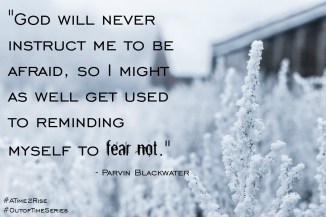
fear-not-2The ending was hopeful and satisfying. Like any worthwhile story, it was bittersweet. I had all my big questions answered, and there’s a promise of short stories to follow to satisfy the rest of my curiosity. I cannot recommend this series enough. I know a lot of people won’t read it because it’s dystopian and that genre is “weird”, but I think a lot of people would be made better by reading it.

It’s easy to see that God was heavily involved in the writing of this series. It isn’t just a good story, it’s a great story. It doesn’t just entertain, it teaches. Therefore, I give A Time to Rise five out of five wonderstruck stars and a PG-13 rating.

P.S. – I received a free copy of this book in exchange for my honest review.

P.P.S. – Seriously, go buy this series.

P.P.P.S. – Why are you still reading this?? I told you to go buy the series!!!

Rise to Forgiveness

One of the themes of A Time to Rise by Nadine Brandes is forgiveness, and as part of The Rise Tour, I decided to write about it.


When I was little, I fought with Bro #2 (Luke–the sibling that’s closest to my age) a lot. We would get into actual fights replete with kicking, yelling, tackling, and all that jazz (I even bit him once—no, I’m not proud of it). We would get caught by Mom and one of us (sometimes both of us) got spanked, and if it was really bad, we got spanked again when Daddy got home. And then Mom would make us hug and make up.

Usually, it went thusly:

Me: *still sniffing from the spanking* “I-I-I’m sorry for [whatever it was I did], Luke. W-will you please forgive me?”

Luke: *still sniffing also* “I-t’s okay, Rosie. I forgive you. S-sorry for [whatever it was he did]. Will you please f-forgive me?”

Me: “Yeah.”

Mom: “Hug.”

Luke and me: *hug*

(Side note: Parents, please make your children do this. It taught us the importance of asking for forgiveness and accepting forgiveness. To this day, as adults, we do this when we fight, and it’s largely because we were taught that it’s important when we were young.)

SONY DSC

Forgiveness. Honestly, it’s a simple concept: someone wrongs you, but you don’t hold it against them. However, in practice, it can be a struggle.

I’ve found that it’s still fairly easy to forgive when someone asks me to (though, honestly, I’m the one who has to ask for forgiveness most of the time). If Arielle (my sister) asks me to forgive her for being a little crabby or if Luke asks me to forgive him for being harsh, I can do it in a heartbeat. I can say “I forgive you”, and it’s over and done with. Even with the bigger fights we’ve had as adults, I can put it behind me almost instantly. But that’s when forgiveness is easy. That’s when my deep love for my siblings overrides my anger. That’s when the hurts heal faster.

I had a friendship slowly dissolve last year, and that was not easy to forgive. That hurt did not heal for a long time. I didn’t have many friends my age, and so when this girl came along and befriended me, I hung a lot (too much) on that relationship. I put a lot of heart into that friendship, and we were such good friends for a while. She’s the type of person who is so easy to trust and get comfortable with, and so I trusted her. It happened kind of slowly, but then I started to notice that she was forgetting me, making new friendships, better friendships. And then in six months, we weren’t communicating at all. Our friendship came and went within the space of two years. There was no big fight, there was no malicious intent or hurtful words. There was just… a loss of interest.

I spent the next six months letting hurt grow and fester into bitterness. I was angry at her for forgetting me. I would see pictures of her and her friends online and be filled with resentment. I spent more than one night crying and wondering what I could have done to keep her as my friend. I was so wrapped up in myself, in how hurt I was, in how angry I was, how much I wanted her to know how she wounded me.

I clung to my bitterness with both hands, but then the Holy Spirit started to convict me. “Forgive as I have forgiven you. I am your friend. I am your comforter. I am your God. I have forgiven you. Now, you forgive her.”

My grip began to falter, but I didn’t want to let it go. “But I want her to know that I’m angry. I want her to know about the pain she caused me.”

“Is it not enough that I know?”

And so it went for a few weeks. He would call me to rise to forgiveness, like He did on that cross, and I would give Him all the reasons why I wasn’t going to. He kept bringing up Matthew 6:14-15 and the parable of the unforgiving servant. And then I had the privilege of beta reading A Time to Rise at the beginning of the year. I learn best if I am shown something, not just told about it, and one of the things Nadine Brandes does best is show forgiveness at its worst and finest.

And the Holy Spirit kept at it. “Forgive as I have forgiven you.”

It took more time, but an essential step was actually saying out loud to God that I forgave her. I still battled the bitterness that ran deep for a few more months, but the Holy Spirit graciously drew it out of me when I asked Him to. The hurt is still there sometimes, and I get sad when I remember the 3:00 am talks I had with this girl, but it’s a pure sadness. It isn’t tainted with anger anymore. It isn’t shot through with hostility anymore.

I couldn’t heal until I forgave. I didn’t have “closure” until I forgave. I didn’t have complete joy until I forgave.

Forgiveness isn’t a feeling or a notion or something that just happens. Forgiveness is an action. You have to be intentional every time bitterness starts to bubble up again. You have to obey the command of Christ, rise up, and forgive.

My friendship with that girl and how it ended was the big, hard thing for me, but maybe you’re dealing with a messy break up or a spouse who doesn’t love you the way they should or a friend who’s betrayed your trust or a child who has wounded you. Maybe it’s something that happened yesterday. Maybe it’s something that you’ve been carrying around for months or decades.

You have to forgive them. You may not feel like it. It’s especially hard to forgive when they don’t know or recognize that they’ve wronged you, but you still are called by Christ forgive. If you forgive, your joy will be deeper, your walk with God will be stronger, and you will have a greater appreciation for what Christ did on the cross.

So, friends. Rise to forgiveness.


All the fun tour stuff:

nadine-headshot-1The lovely author:

(I personally recommend the newsletter because it’s so much fun as well as checking out her Instagram because it’s mainly of books and so lovely to look at.)

Also, she can speak HTML, and so that’s just another amazing thing about her.

The books.

Guys. Do we even need to go here? Like, seriously, if you’ve followed Penprints for more than a week, you should have already read this series by now. In the event that you haven’t read the series (shame, shame), here are the beautiful covers to stare at and the buy links below to GO BUY THE SERIES.

all three covers

A Time to Die

AmazonBN-iconlogo EvxYrjm7_400x400goodreads icon

A Time to Speak

AmazonBN-iconlogogoodreads icon

A Time to Rise

AmazonBN-iconlogo goodreads icon

A Time to Party

And also you (yeah, you) should come to this awesome Facebook party because you can chat with Nadine and enter to win soooooooo many cool things.

nadine-party-1

And thus ends my post as part of The Rise Tour.

~ Rosalie

P.S. – you can expect a review of A Time to Rise sometime next week, but it’s taking a while to write because one does not simply write a review of the final installment of The Out of Time Series.