A Brief Survey of Bible Reading, Bible Study, and Personal Devotions [their similarities, differences, and such]

We’ve got a few housekeeping things to get out of the way: 1) I’m not going to give a good reason why this post is so late because there isn’t one 2) November is my blogging break month, so no Penprints posts (keep a weather eye on the Facebook page for any momentous updates) 3) I’m doing NaNoWriMo for the first time in a few years!!! 4) there’s probably something I’m forgetting.

DSC03887.jpg

Bible reading.

What it is: Reading the Bible. Here’s what you do: grab your Biblical text, settle in somewhere, and read through a chapter or book of the Bible (I know, we were all kind of unsure).

What it doesn’t do: Bible reading alone cannot nourish a soul. Scripture is the richest soul-food, but you can’t be filled up by something just by looking at it, or even putting it into your mouth. You have to chew on it, swallow it, and make it part of who you are (more on that later).

Bible reading “done well”: The best Bible reading springs from a heart realization not that you should read the Bible but that you need to read it, that if you don’t read it, you won’t survive. The best Bible reading is approached with hunger and humility. It’s Spirit-led, and both the mind and the heart are engaged, soft, and meditative/contemplative.

Why do it: The Bible is how God decided to tell us about Himself; it’s His chief form self-revelation. So, from a desire to know God flows the reading of His Word, and from reading the Bible comes a heart and mind that are saturated with Scripture.

Bible study.

What it is: Intense, extensive study of the Bible. This involves examining the context, wording, grammar, cross-references, etc.. The passage(s) in question is read and then reread and then rereread. Notes are kept, questions are asked, and answers are found. Theoretically. (Or, my favorite thing ever: I end up with more questions than I had when I started).

What it doesn’t do: Bible study alone cannot feed the soul. An exercise of the mind without the engagement of the heart will result in knowledge but not nourishment.


Bible study “done well”: Approach Bible study with much prayer and openness. It’s something to do with God, to enjoy and discuss with Him. Check yourself to make certain you’re delighting in the Word itself and God Himself and not in the discovery process. There’s a special thrill in realization and finding an long-sought answer, and it’s good to enjoy that bit of satisfaction… but it shouldn’t be the primary source of our satisfaction and joy.

Why do it: 1) Because we’re commanded to do it (2 Timothy 2). 2) Investigation is a byproduct of a healthy, worshipful heart. 3) We’re called to be stewards of God’s mysteries, and while they’re called “mysteries” for a reason (i.e. – we don’t even know what we don’t know about them, and we likely never will), it’s our responsibility as stewards to share our knowledge with others… and how can we share it if we don’t have it? And how can we have it if we don’t look for it?

Personal devotions.

What it is: Personal devotions (aka: quiet time, devos, or Jesus time) is where Bible reading, study, prayer, meditation, worship, and self-examination all come together to create rocket-fuel for the Christian life. This is where the heart, mind, soul, and strength strive together know God and then be like God. This is where the mind is renewed and the soul feasts.

What it doesn’t do: Doing devotions can help equip you to grow and live the Christian life, but you have to do just that: live the Christian life. Just as faith without works is dead, what you taste and see in your quiet time is dead if it isn’t translated into your everyday life.


Personal devotions “done well”: I don’t think there’s really a right or wrong way to do devotions, and I think that they will look a little different for each person, but there are a few universal principles.

If you don’t do it with the Holy Spirit, it’s worthless; so ask for the Holy Spirit (and really mean it). Be purposeful and intentional. Strive to be undistracted. Don’t lie to yourself or God about what you find in the text or yourself. Do it every day (that includes weekends) as much as possible.

Clarifications: Devotions are not reading a book about the Bible. Yes, you can read a book about the Bible, but you must balance it with actually reading the Bible itself. You can have a guide or commentary, but it’s important to remember what someone says about God’s Word isn’t as valuable as God’s Word itself.

Devotions are not public. This means you don’t broadcast them (i.e. – don’t do it in a public place, and don’t post about doing it on social media).

Devotions are not meant to be preparation to teach others. Pastors, small group leaders, and other teachers should have a time separate from sermon/lesson/discussion preparation outside of the their devotions. Devotions are where the Holy Spirit meets our personal needs, and teaching can spring out of that, but teaching should not be the goal. Knowing God should be the goal.

Devotions are more involved than Bible reading and Bible study alone because it incorporates more spiritual disciplines (more time spent in prayer, worship, reflection, application, etc.).

Devotions won’t always look the same for all people. Sometimes there will be more study time, sometimes much more prayer, sometimes more simple reading and relishing the Word, sometimes more worship, and it all depends on each person’s season in life and specific needs.

Why do it: If we want to know and be like God, we won’t just think about wanting to know and be like Him; we’ll ask Him to help us know and be like Him. And if we want to know and be like God, we won’t just ask for His help and sit on our hands; we’ll read His Word. If we want to know and be like God, we won’t just read His Word; we’ll meditate on it. If we want to know and be like God, we won’t just meditate on His Word; we’ll study it, knowing that in studying it, we are studying Him. And if we want to know and be like God, we won’t just study Him; we’ll ask Him to help us know and be like Him.

And so the cycle continues, the desire followed by the asking followed by the reading followed by the mediation followed by the study followed by the asking again, and the soul that goes through that cycle will follow it with action–changed thinking and behavior and way of life. And the soul that is characterized by hearing and then doing will be the soul that grows up into the image of Christ.

A few warnings.

Any spiritual discipline can easily become a rite of religion we do because we know we should.

As our eyes skim the verses during Bible reading, our brains can drop into autopilot, and the God-breathed words–the most powerful words ever to be said and printed–become nothing more than black shapes on a sheer white page. They go in before one blink and out after the next, and we have a vague sense that something about grace is being said, but we don’t really what it is, just that it’s something to grace and glory to God the Father of our Lord Jesus Christ and other such Bible jazz.

When conducting intense study, the Bible can quickly become a textbook, and turning the Bible into a textbook is dangerous because it’s not a textbook. The Bible is the special self-revelation of God, a Being we don’t and never will understand. Yet, when studying the Bible, it is so easy for it to become an intellectual pursuit, engaging every cylinder of our minds while leaving our hearts and souls unaffected by the knowledge.

Pride is another danger, and when I say danger, I say it with flashing warning signs and blaring sirens because pride is a fire no one can get close to and not be burned. Pride in efforts or “results” from Bible reading, study, etc. is so appallingly natural; it’s the road our old nature wants to race down headlong given any opportunity. (And before you say you don’t have pride, you need to think again.)

Keep guard against legalism setting in as you seek to establish healthy habits, and always remember that grace super-abounds.

Don’t do one or the other; do all three.

Read your Bible outside of your devotions time. Learn to delight in it, pleasure read it. Regular, extensive Bible reading is not what “good” or “devout” Christians do. Regular extensive Bible reading is what hungry, needy, weak-and-owning-it Christians do.

Study your Bible outside your devotions time. Look into all the things that raise questions, seek and find answers. Puzzle over all the mysteries and come as close as possible to understanding all of them.

That’s all for today, kids.

So we’ve come to the end of my brief survey. What are your personal definitions of these things? Anything to add or object to? What do your devotions look like right now?

With love,

Rosalie <3

P.S. – This post was supposed to go up yesterday, but then I lost the feature image and was too annoyed to figure out a new feature image at 11:05 pm on Sunday, and so here we are on Tuesday.

P.P.S. – I think I might be moving toward a final redesign soon (and, of course, I’m using “final” in the loosest sense of the word)!

P.P.P.S. – there’s probably a typo or two in this post, but I’m kind of beyond caring at the moment (you know when you’re wandering around the house in sweatpants with two day old makeup on your face, a mug of thrice-reheated coffee in your hand, and and bed hair? Yeah, I’m right there. Figuratively.).
Glossary of Terms

It’s about time Penprints gets a glossary, don’t you think? (It doesn’t really matter because I think it, so it’s happening. ‘Tis the power of a blogger (and, no, I’m not a petty tyrant).)

glossary 2.jpg

WIP: Work-in-progress; my current writing project.

Beasts: my retelling of Beauty and the Beast; the fourth draft is sitting in a vault in a hole so deep that earth’s core is starting to melt the vault box somewhere.

An Idea: a white-hot spark of story fragment that’s growing into Something.

Editing: the spawn of lightning and death (wait, that’s Toothless, and he’s delightful) the part of writing where the Something is painfully, intentionally, ruthlessly carved into a Story.

False Gods: my YA Middle Eastern Fantasy; some of this story astonishes me; I think I might love it.

Flash Fiction: remarkably short stories (1000 or less) which I’m a little mad for.

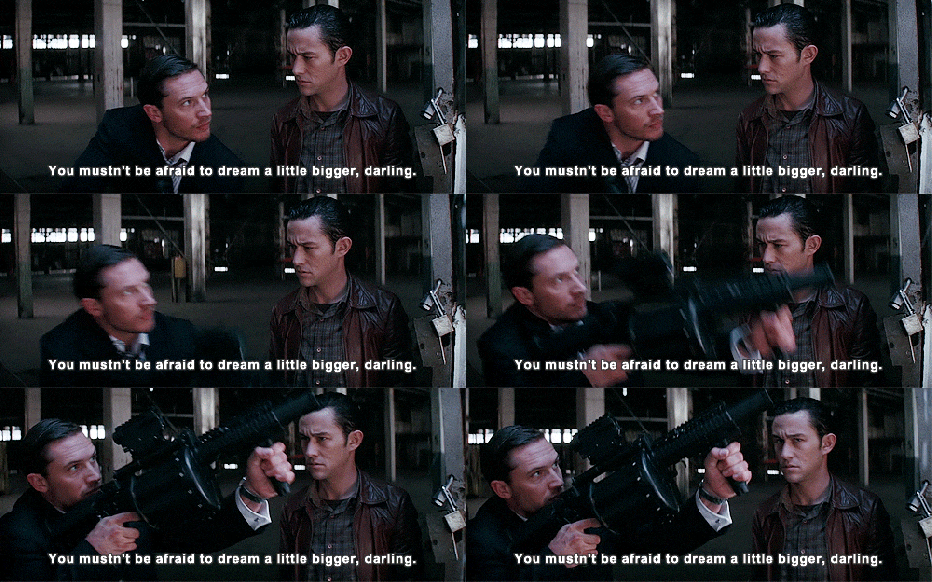
This gif:

dream bigger 1

no explanation necessary

Fire: ignited matter that feeds off of oxygen and produces light, heat, and beauty; my muse.

The Oxford Comma: the little guy who should always (always.) come after the second item in a series of three (so help me).

The Secret Life of Walter Mitty: only one of the most galvanizing movies to ever be made; one of my favorite movies.

Winter: the most glorious of the four seasons.

Copious, Long, and Confusing Parenthetical Statements: I have an affinity for the bit a grammar that goes like this: (-). And I also like nesting my parenthetical statements (sure, I could use commas (because one can never have too many commas, right?), but commas aren’t nearly as fun as parentheses (you know I’m right)).

Bullet Journal: the nigh magical system that has brought a measure of order to my chaos and spawned this post, this post, and then this post (notice the Oxford comma?)

The Necklace: my first published story!

Our Family: the incredibly hard-to-write-but-so-worth-it flash fiction that ended up being my second publication!

The Middle Distance: actually, I’ve never referenced The Middle Distance anywhere on this blog, but sometimes you just have to throw something in for The Lolz (aka: this entire post).

Tony Reinke: only one of the best nonfiction authors of my lifetime. Start with Lit! and then go for 12 Ways Your Phone Is Changing You; you can thank me later. (It’s later.)

Nadine Brandes/The Out of Time Series: lololololololol, if you’ve been around Penprints for more than two seconds, you know what this is. For those of you who’ve been here for less than 2 seconds, I shall briefly explain. Nadine Brandes is an incredible author, and The Out of Time Series is her equally incredible debut series. So now it’s been explained; go read it and thank me later. (It’s later.) Also, Fawkes.

TBR: the infamous To Be Read list of books that is ever-growing and only diminishing in increments of not at all.

And that’s it for now, kids.

With love,

Rosalie

P.S. – The Glossary is updated every few months.

4 Thoughts on Cultivating an Appetite for God

We (Christians) often talk about desiring God’s Word and God’s will and God’s glory and God’s blessings and God’s work and bunch of other things of God, and all those are good things, the best things, actually. Yet frankly, wanting the things of God is meaningless without wanting God Himself.

So let’s talk about cultivating an appetite for God Himself because so often I’m too distracted to chase, not the things He does or says, but simply (yet not at all simply) Him, God, Yahweh.


4-thoughts-appetite 2.JPG

Why crave God?

What’s the difference between yearning for the things of God and yearning for God Himself? Is there a difference?

They’re entangled, feeding into each other at different times, but they are not the same. God is a Person, not a thing, and the things of God are just that—things, not God. And the things of God do not satisfy the soul. They don’t fill up the cracks and crannies and canyons of the soul. They do not fill the soul to overflowing, to bursting; God does that. God satisfies and floods to the point of brimming and spilling over, and it is God, who crafted the soul, who can truly meet all its needs and longings. So that’s why we must go after an appetite for God—because in Him is the fullness of joy.

The appetite.

Perhaps it goes without saying, but I’m going to say it just to be clear: you and I cannot make ourselves hungry for God. There’s nothing we can do on our own to work ourselves into a true, salivating, soul-rumbling hunger for God. As it is with all things, we must first ask God to open us up to it, ask Him to give us what we cannot get on our own: an appetite for Himself.

This is not a “step” to breeze over because of its plainness or elementary nature; without this, the rest falls to pieces. Appetite is not based solely on craving, but instead craving and simple need are knotted together, and out of that comes the hunger. Thus, recognizing the base need and bringing it before God in spirit and in truth is where this all begins. So don’t skip this part.

Second, I think we need to return to wonder. I’ve been in church since the womb, and I get quite comfortable with God, used to Him (or, at least, I’m used to my idea of Him). God can seem stale to me, and I don’t think I’m alone in this. I’m hardly amazed by God, not because He isn’t amazing but because I’ve lost wonder.

Let’s take something that seems so simple, something I’ve sung since before I can remember, something I careen past unthinking, unfeeling every day: “Jesus loves me this I know.”

Take a moment and think. Jesus loves me. Jesus loves you. Consider who, what Jesus is—the image of the invisible God; the One by whom, for whom, and through whom the universe was created and is held together; the second person in the triune Godhead; the One so holy that it’s shouted back and forth in heaven and again and again and again, “Holy, holy, holy!”; the One who is so much beyond us, before us, that we can’t hope to express it. And this is a short, basic version.

Now, consider who you are, what you are—dust on a pale blue dot suspended in a universe wider and wilder than our minds can fathom. Now, not paying any attention to the things you and I have said and done, let’s go straight for the jugular: the things we think and feel. Varying degrees of indifference to God because He isn’t us. Varying degrees of disgust for others because they aren’t us. Not-really-varying-degrees of love for ourselves because we are us.

I’m an incredibly self-absorbed creature; so much of the time, I think of the world (and scarier yet—God) in relation to me, how I think things should be done, how it affects me, how other people make me feel, everyone else’s flaws, all my virtues. My world is me. My universe is me. (And remember, this is the short, blurry version because I can hardly bear to think about, much less write about, the seemingly endless, excruciatingly specific list of ugly things in me.)

Now, let’s put the two together. Jesus loves me. And since He’s the omniscient God, He knows all about that seemingly endless list of ugly things with more clarity than I can dream of and shudder to think of. And since He’s the Most Holy One, in my twisted, fallen, hideous state, I am an affront to Him, an offense to His awesome purity. Yet, He has decided to love me, has swept all that away, has given me His purity, His goodness, His righteousness, His holiness so that I might regain what was lost in Eden—the chance to come spotless before God and offer worship.

So that’s what I mean when I say that an appetite for God means recapturing wonder, and wonder is found in stillness and thinking. It’s been said that when you think about something for any lengthy bit of time, you can’t help but find wonder in it. So take time to wonder at and in God, to be broken and weeping at what you see in yourself and to be trembling and gasping at what you see of God. Seeing God with wonder, seeing Him as He really is, cuts open this profound need to see Him more. So we ask Him to graciously show us Himself, and then we take time to be wonderstruck.

Third, look for someone(s)—living or dead—whose appetite for God is/was worth emulating. And then emulate it.

For me, that’s the Psalmists (especially David), my brothers (Caleb and Luke), and A.W. Tozer.  See what they’ve done (or are doing) that compels them to want God so badly, and do it yourself. For me, it’s been reading Scripture, talking with my brothers, watching my brothers in their lives, reading good books, reading the Psalms aloud, and hearty, honest prayer.

Lastly, we have to eradicate the things—anything—that dulls our appetite for God, remove anything else that would slake our hunger and thirst (because we’re always hungry and thirsty for something; it just varies on what we fill up on). Locate the junk food in your life and cut it out. This can really be anything. Some will be sin, the obvious ones to get the axe. Slander. Fits of anger. Pornography. Gluttony. Lying. Slothfulness. Whatever it is, it needs to go. And then there are the less obvious ones, the ones that aren’t wrong per ce, but they also aren’t helpful (the whole lawful vs. helpful business). If it’s not increasing your appetite for God, it’s curbing your craving for Him. Whatever it/they is/are, we have to ruthlessly cut it/them out.

The paradox of it all.

God fulfills us, yet we can never get enough of Him. A voraciously hungry soul is fed beyond all contentment, yet is never satisfied. It’s absurd, enigmatic, too puzzling for me to actually understand, but I’ve found it to be true myself. A. W. Tozer puts it like this: “To have found God and still pursue Him is the soul’s paradox of love.”

The end of the matter (or rather, the end of this post).

An appetite for God doesn’t come about overnight (much to my dismay), but when it comes, it comes in intense hunger pangs because once the living God reveals Himself to a craving soul, even just a sliver of who He is, all that can be done is to lurch after Him, gasping, searching, crying out “More!”.

 “O God, You are my God; earnestly I seek You; my soul thirsts for You; my flesh faints for You, as in a dry and weary land where there is no water.” – Psalm 63:1-2.

What do you think? Any suggestions to add for cultivating an appetite for God? Where is your appetite?

With love,

Rosalie

P.S. – the topic of this post was decided by the lovely people over on Twitter. Thanks for voting for your favorite topic, Twitter peeps! I could not decide for the life of me.

The Sunshine Blogger Tag

Lisa from over at Inkwell tagged me a couple weeks ago in The Sunshine Blogger Tag! It’s a fun tag with simple rules:

– Answer the eleven questions you’ve been tagged with

– Create eleven brand new questions

– Tag up to eleven people

So thank you for tagging me, Lisa! You came up with some fantastic questions!

Let’s get this party started.

sunshine-blogger-tag

Question #1: What would be your second choice career (other than that of a writer)? Or, if you aren’t going to be a full-time author, what’s your job choice?

Well, writing doesn’t pay well, and so I’m going to have to do something along with writing/blogging so that I can live, buy books, and eat food.

food 5


food 2

food 6.gif

food gif

food 4

What, uh, oops, I got a little distracted. AHEM.

This is actually something I’ve been thinking about a lot recently (not eating, the whole second job thing), but it’s all still very much up in the air right now. I’m thinking possibly (emphasis on “possibly” here, people; major emphasis) massage therapy, Spanish interpretation, freelance editing, or graphic design.

Buuuuuuuut, I’m thinking probably not those last three (I know, like, can I just please make up my mind on what’s even going to be on the “possibly” list for goodness sake???) because I like tactile work, something that I would do as much/more with my hands than my head because it’s earthy and honest and hearkens back to simpler days. (Though, there’s a distinct possibility that whole last bit is just a mental thing I have in my little romanticizing heart.)

Question #2: Out of all the people you personally know (not internet friends) who has been the most encouraging/enthusiastic about your writer’s life and your works?

Haha, this one is easy: my Dad. He reads everything I write. After each blog post, he sends me an email with his comments and thoughts on the topic of the post/the post itself. He reads all my flash fictions, and then he rereads them a bunch of times when I hand him draft after draft after draft so that he can give me his thoughts. And I think he read the Alpha Draft (aka: Draft Four) of Beasts in two days. He’s always incredibly encouraging and offers such fantastic advice and helpful (and gentle) criticism, and he wants me to do what I need to do to be able to write as much as possible. He is, by far, my biggest fan.

Question #3: How would you want to die if you were to be killed by the villains of a fictional world you accidentally entered?

Ummmm, very quickly. That’s about all I’ve got for that one.

no expert gif

Question #4: Who’s your favorite animal character of all time? (Out of a book, friends, not a movie.)

Breehy-hinny-brinny-hoohy-hah (or, more simply, Bree) from The Horse and His Boy by C.S. Lewis. Oh, goodness, this horse. So much tude. So much sass. And also very vain and arrogant until he meets Aslan, which is something I relate to personally.

Question #5 Are you more excited about writing the dedication or the acknowledgements in your book?

Probably the dedication. I think the dedication is for the heart of the book, and the acknowledgements are for the village that raised the book.

Question #6: In one sentence or phrase, describe your writer’s life motto – preferably using symbolism and metaphors. It can also be your mission statement kind of thing.

Okay, I’m going to share my super secret writing manifesto that I will probably be putting on my new business cards (whenever I get them) and plastered all over my author website (whenever I get that set up).

Here we go: stories that are sweet aromas to Christ and signal fires to the world.

It may get tweaked, but that’s the general idea.

Question #7: Pick one song that best describes what you aspire to be.

Hahahahahahaha–easy.

To Live Is Christ by Sidewalk Prophets. Go watch the lyric video. Get chills. Cry. Lose your life in Christ. Thank me later.

I was going to share a few of my favorite lyrics in this post, but then when I was trying to choose, I realized that the whole song is my favorite lyrics, thus, we came to a conundrum. So excuse me while I paste the entirety of the lyrics below.

If I rise, let me rise on You,
Not on all of my successes, my esteem, or my pursuits,
If I lose, let me lose my life,
‘Cause if I belong to Jesus, the flesh is crucified.

For me to live is Christ,
For me to live is Christ, to die is gain.

If I grow, let me grow in You,
Wilt the seeds of wanting more,
Rippin’ pride out by the roots,
And if I’m still, let me hear You speak,
Not the tone of my transgressions,
But the song of the Redeemed.

For me to live is Christ,
For me to live is Christ, to die is gain.

My great desire is to be with You,
But this is the place You chose for me,
This is the place You chose for me,
To lift my cross and give everything,
This is the time You gave to me,

For me to live is Christ, For me to live is Christ,
For me to live is Christ, to die is gain,
I’ll never be the same, I’ll never be the same,
For me to live is Christ, to die is gain.

But, basically, just go watch the lyric video.

Question #8: Do you listen to podcasts? If so, what are your favorites?

Yesssssss! I’ve recently been listening to podcasts more and more! So, my current favorites: Bright Eyes (sci-fi podcast), Ask Pastor John, Sermon of the Day, and TED Talks Daily. I get my fiction fix from Bright Eyes, edification from Ask Pastor John and Sermon of the Day, and then random curiosities from TED Talks Daily (though, I’ve found that TED Talks tend to be politically correct and leftist a lot of times, but there are still some good ones, like the one about creating safe artificial intelligences).

Question #9: If you had to rename your blog, what would you call it?

Renaming the blog?

who me.gif

Lol, that’s never happened before. Don’t be absurd.

Anyhoo, if I had to rename it at this point, it would probably be something like Chirospasm (because it means “spasm of the muscles of the hand; a writer’s cramp”, and that’s basically my life), Glass Houses (a suitably mysterious blog name), Of the Soul (a suitably overly existential crisis name), High Command (because, seriously, you guys getting emails from “High Command” would just be too good), or The Pale Blue Dot (after the picture of earth taken from space that shows earth as “a mote of dust suspended in a sunbeam”).

Question #10: What would you want written on your tombstone? (Got this one from a biography where a girl said she wanted “She lived life to the fullest” written there. Something of that sort, friend.)

If I were to have a tombstone, I would want Philippians 1:21 (For me to live is Christ, and to die is gain.) or Psalm 27:4 (One thing have I asked of the Lord, that will I seek after: that I may dwell in the house of the Lord all the days of my life, to gaze upon the beauty of the Lord and to inquire in His temple.) carved on it.

Question #11: You know you will die in one year. What do you want to do in that time?

One year to live (in no particular order):

– read through the Bible one more time

– visit all my family

– write and publish a collection of flash fictions

– write one more book

– memorize Philippians

– quit apologizing (verbally or internally) for my tastes, interests, callings, or anything that is not actually apology-worthy

– get a tattoo (shhhhhhhhh, don’t tell anyone; actually scratch that and see the previous item on this list)

– sing my soul out more often and not care how it sounds or who’s listening

– reread the Out of Time series by Nadine Brandes (shocker)

– make a disciple or two

– wear sweatpants in public with no shame because life is truly quite short

– get rid of my smartphone

– NF (not finish) books more often because I don’t have time to waste on books I find “meh”


Questions for the peeps I’m tagging:

  1. What is the last 5 star book you read? What made it a 5 star read?
  2. What makes you feel most alive?
  3. Name a fictional character who as impacted you in some way.
  4. If you didn’t have to sleep, what would you do with all the extra time (besides write or read)?
  5. In one sentence, share your philosophy for life.
  6. Use a gif to describe your default mood.
  7. What are 3 little things that make you incandescently happy?
  8. Are you primarily feeling or logic driven?
  9. What is the thing that makes you write even when you hate it?
  10. If you were a dictator, what 3 main policies would characterize your regime?
  11. What song do you always play on repeat?

Katie Grace of A Writer’s Faith, RubySky of The Sea Calls Us Home, Moya Tobey of An Existence Transcribed, and Alea Harper of Elvish Pens, Fantastical Writingstag, you’re it. *sunglasses emoji*


Now, let’s talk, kids. What are your answers to some of these questions???

With love,

Rosalie <3

P.S. – I feel like I’m forgetting to tag someone who I really want to tag, but I can’t remember for the life of me who it is. This is frustrating. So, I might tag another person if I can remember. Or I may never remember. I guess we might not know.

P.P.S. – and have you watched that To Live Is Christ lyric video yet?

Mastered by Nothing [a beginner’s guide to self-control] [written by a beginner]

A couple weeks ago in my post about writing and its negative potency in my life, I talked very briefly on the idea of being mastered by everything but Jesus. Well, today, I’m digging into the idea and worthy goal of being mastered by nothing but Jesus.

So let’s roll up our sleeves and get going.

mastered-by-nothing.jpg

“All things are lawful for me,” but not all things are helpful. “All things are lawful for me,” but I will not be dominated by anything. – 1 Corinthians 6:12

At the core of this post is I Corinthians 6:12, and at the heart of 1 Corinthians 6:12 is self-control. Originally, this verse was specifically about self-control in the area of sexual sin, which is important to remember, however, I think there is much to be gleaned here regarding self-control in all areas of life.

As Christians, we have great freedom because of the liberty Christ bought for us with His blood (literally, He paid for every angle of our freedom as Christians with His blood; the more I think about it the wilder and more wondrous I realize it is. So don’t breeze over the truth of the high cost of our freedom.).

Not only are we free from bondage to sin and spiritual death in this life and the next (a thrilling and freeing truth by itself), we are also free from the need of a temple to offer sacrifice in because Jesus was the last sacrifice. We are free from the need of a priest to mediate between us and God because Jesus is our high priest. We’re free from every rule and ritual of the Law because Jesus fulfilled the Law.

We are free to do anything, but not everything will help us be like Christ. We are free to do anything, but we are not to be slaves to anything but Christ. What I mean when I say that we’re free to do anything is that we are able to do anything because the grace of God doesn’t ever end and will never be used up, so we are “allowed” to do anything. However, doing absolutely anything is an abuse of grace. Paul says in Romans 6: “What shall we say then? Are we to continue in sin that grace may abound? By no means! How can we who died to sin still live in it?”

So, let me say it again: under grace, all things are lawful because the Law is fulfilled and ended in Christ, but just because we can do it doesn’t mean we should. Under grace, all things are lawful because Christ set us free from the rule of the Law, but we are not to be controlled by anything. I think that’s the gist of 1 Corinthians 6:12.

Yet we so easily abuse our incredibly expensive, blood-bought freedom.

I misuse my liberty in a lot of different ways. I do things that are “allowed” but aren’t all that helpful, things that don’t spur me to be like Christ. I have habits and mindsets that aren’t forbidden but they’ve grown to a place where they rule me instead of living under my control. We can be mastered by host of different things, but I’ll just give a few examples.

I am mastered by my body when my alarm goes off and I hit snooze five times because I want more sleep and don’t have enough control to just get up (it’s a simple yet telling practice of the state of my self-discipline).

I am controlled by my cell phone when every little ding and blip and whistle has me tugging my phone out of my pocket and scrolling through notifications instead of devoting myself fully to the task at hand.

I am enslaved to my cravings and emotions when I breeze into the kitchen because my story just got rejected and I need some comfort food instead of dealing with rejection in a healthy, godly way.

I am dominated by my body when my hormones are on a warpath, and my anger comes lashing off my tongue.

I am mastered by my emotions when depression creeps up and drags me down into the mud, and instead of doing the work to haul through it, I wallow in it.

I am controlled by my aspirations when writing fills my thoughts, whips my emotions, and dictates my time use (see the post from a couple weeks ago).

And there are so many other things that so often end up controlling us: anxiety, money, sex, body-image, hobbies, possessions, ambitions, etc.; the list goes on and on.

And here’s the deal: sleep is necessary; sleep is good. But my body and however sleepy or tired it is should not rule me. My cell phone is good, but my cell phone should not control my attention. Food is necessary; food is good. Food is to be enjoyed and savored! But my desire for food for any reason should not master me. I have been created with hormones and emotions, and they do need to be processed. But that’s the things: I need to process my feelings, but my feelings should never process me.

I am free to sleep in and have a cell phone and eat yummy food and experience a full range of emotions, but not all those things are always helping my new nature slay my old one. I am free to sleep in and have a cell phone and eat yummy food and experience a full range of emotions, but none of them should ever control me.

So that leaves us with the problem of self-control. Self-control (or self-disciple or self-restraint) is one of those annoying things that’s far easier said (or written or read) than it is lived. So how can we make our bodies and emotions our servants instead of our masters?

Well, we can’t. This is the part that gets my pride all fluffed up, offended, and territorial because what in the world do you mean I can’t control myself?

Self-control isn’t a matter of self; it’s a matter of Spirit. Either we are controlled by whatever our personal vices are, or we are controlled by the Holy Spirit. There is no in between or part where we actually hold the reigns; we only get to decide who/what we’re going to pass the reigns to.

Self-control is one of the nine fruits of the Spirit mentioned in Galatians 5, and it’s one of eight attributes listed in 2 Peter 1. Both lists are like the process of sanctification in a nutshell. True believers will grow in these ways, but true growth is not a matter of willpower or work. Self-control is something to strive for, but we don’t get it overnight. It’s a process. And just like every other part of sanctification, it takes humility and time and intentionality and Spirit-reliance and daily, hourly, minutely gracious refillings of the Holy Spirit.

Recognizing that we can’t do it ourselves, that we’re still so weak, is the first step, and the next is faithful pursuit of knowing Christ and being like Christ. And then it’s a cycle of choosing to take those steps again and again and again.

In the everyday life, it looks like praying, “God, I can’t do this, but I want to because I want to be like You. I will run as hard and fast as I can to You, and I will trust that Your Holy Spirit will supply everything I lack to carve me into a better likeness of Your Son.” It looks like then asking in faith and expectation for opportunities to exercise self-control, to be shown where you need self-control, and prepare to be given lots of chances to practice self-control.

So, it is in being mastered by Jesus that we become mastered by nothing else.

Let’s drop a swanky bookend on this post.

As the title of states, this is only a beginner’s guide, and since it’s been written by a beginner, take it with a grain of salt and realize that this is barely even an introduction to self-control. For further reading on grace, sin, and self-control, I recommend Romans, 1 Corinthians, Proverbs, Ephesians, and this sermon from John Piper. (I’m recommending the whole books instead of specific verses because the fullness of the text is captured within its context, and the sermon from John Piper helped me write this post. Also, there’s a lot more to be found in Scripture about self-control; these are just the books I’ve been reading and ruminating over recently which spurred the writing of this post.)

Let’s chat it up. Anything to add? Do you struggle with self-control, or is there a different fruit of the Spirit/quality that you’re working on? What do you do to grow into the likeness of Christ?

With love,

Rosalie

P.S. – so, about the clickbait feature image of the Lego Loki in the tiny birdcage… well, I was racking my little brain about what I could photograph to capture the idea of self-control. I decided on the birdcage, and I was going to run with it and contrive some sort of decent explanation (like, we have to “cage our old nature” type thing; so brilliant, I know). But then I saw my little Lego Loki (curtesy of my Aunt Lis!), and then I was like: “Forget trying to make this picture relevant to the post or anything in life really. Some silliness is in order.”

And that’s how Lego Loki ended up in the tiny birdcage on Penprints.